
Sierra Leone Seeks Coffee-Led Economic Partnership with Russia


Korovy Val, Russia, October 30, 2026 - Sierra Leone's Deputy Minister of Finance, Madam. Isata Marah, has outlined a framework for deepening economic cooperation with Russia through the country's coffee sector, calling for a partnership that goes beyond trade to include investment, cultivation, processing and access to reliable markets.
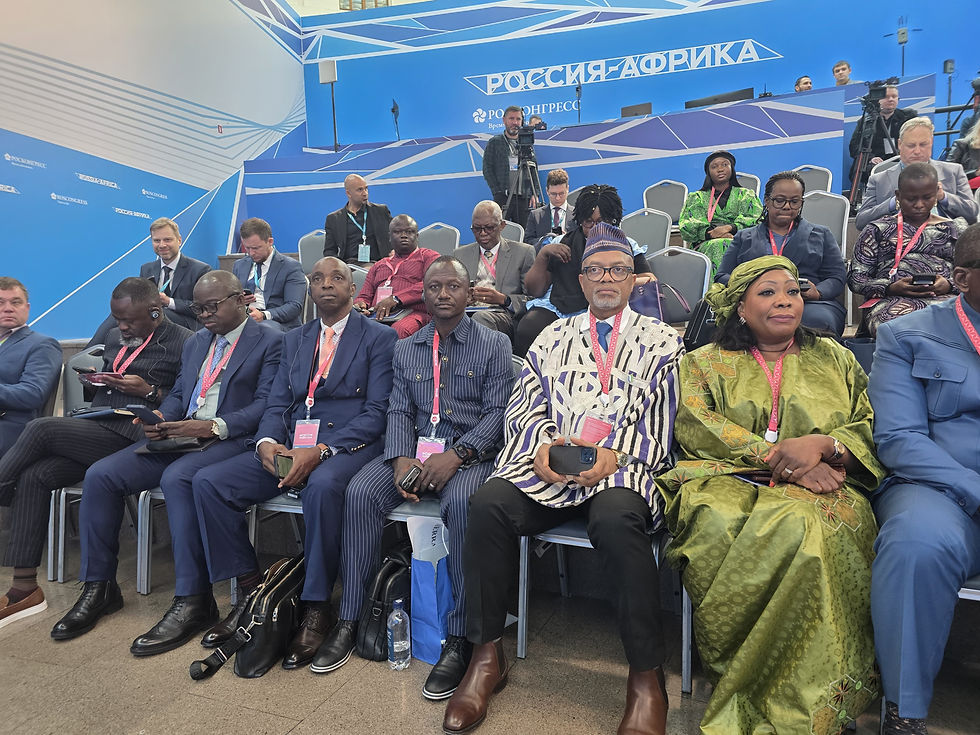
Speaking during a panel discussion on *"Economic Cooperation between Russia and Africa: The Path to Equal Partnership,"* the Deputy Minister said Sierra Leone is seeking a model of engagement that transforms mutual interest into productive investments, expanded trade and long-term economic benefits for both countries.
Madam Marah referenced remarks made in October by Sierra Leone's Ambassador to Russia, H.E. Mohamed Yongavo, who identified two key avenues for cooperation: direct purchases of Sierra Leonean coffee and investment in coffee cultivation across the country.
She noted that while direct sourcing could help reduce intermediary costs, it would not eliminate customs duties or other regulatory obligations. She stressed that Sierra Leonean coffee must continue to meet certification, traceability and quality requirements in destination markets.
Turning to support for prospective investors, the Deputy Minister highlighted the role of the National Investment Board's Investment and Export Promotion Directorate, which provides investment information, investor facilitation services, export support and market advisory assistance. She said the aim should be to create a coordinated and transparent process through which investors clearly understand where to engage, what documentation is required and how proposals will be evaluated.

Madam Minister further identified commercially viable partnerships as a second pathway for cooperation, including direct purchase agreements with existing exporters, joint ventures with Sierra Leonean businesses and outgrower schemes that connect farmers to dependable buyers.
According to her, a credible long-term purchase agreement based on clearly defined quality standards and fair payment terms could deliver greater results than broad declarations of support.
Addressing land acquisition issues, she emphasized the importance of adhering to the provisions of the Customary Land Rights Act 2022, which contains safeguards relating to informed consent, registration, lease conditions and environmental protection.
She said investors must engage lawful landholders and relevant authorities, respect community rights and clearly define obligations, while ensuring that projects do not undermine livelihoods or food security.
On investment incentives, the Deputy Minister cautioned that any proposed incentives must be approved by the appropriate authorities and justified by measurable economic benefits. She stressed that no specific exemption, subsidy or sovereign guarantee should be promised before the completion of the required appraisal and approval processes.
*"Investment ambition must be accompanied by fiscal responsibility,"* she stated. Marah also highlighted the public-private partnership framework as a model for cooperation. Coordinated through the National Investment Board's PPP Directorate and the Ministry of Finance's Fiscal Risk Division, the framework can support project development, feasibility assessments and contractual arrangements relating to logistics, energy and infrastructure.

She noted that any public participation must satisfy requirements for value for money, affordability and prudent risk allocation.
Outlining Sierra Leone's broader priorities, the Deputy Minister called for increased value addition, emphasizing that the country aims to *"export more value, not merely more volume."* She also stressed the need for reliable trade arrangements backed by enforceable contracts, compliance with customs, banking, anti-money laundering, skills and technology transfer, and a commitment to financial discipline and sustainability.
As a practical next step, she proposed beginning with a small number of well-prepared projects by assessing existing coffee supply, testing direct purchase arrangements, evaluating processing opportunities and considering new cultivation initiatives where conditions permit.
She clarified, however, that these proposals remain subjects for discussion and do not constitute an approved bilateral programme between Sierra Leone and Russia.
Among those in attendance at the panel discussion were Mr Julius Daniel Mattai, Minister of Mines and Natural Resources; Ambassador Col. (Rtd.) Alhaji Fanday Turay, Esq., Minister of Transport and Aviation; Mohamed Yongavo, Ambassador Extraordinary and Plenipotentiary of Sierra Leone to the Russian Federation; Ing. Hadji Dabo , Chairman of the National Minerals Agency; Ing. Francis Nyama, Deputy Director General of EDSA; Sahr Nepor, Corporate Secretary of EDSA; Alusine Timbo, Deputy Director of Mines at the National Minerals Agency; and Deen Henry Masala Chukuameka, Deputy Director of Geological Survey at the National Minerals Agency. Senior officials from EDSA, the Ministry of Mines and Mineral Resources, the Ministry of Finance, the National Minerals Agency and staff of Sierra Leone's Embassy in Russia also attended the event.

For inquiries:
Festus J. Lahai
Information Attaché
Embassy of the Republic of Sierra Leone
Moscow, Russian Federation


Comments